Home
Offers & Tracking
Offer Traffic Optimizations
Forwarding Rules
Forwarding Rules

SERIES:

Complete Guide To Offer Traffic Optimization

Forwarding Rules

Forwarding Rules let you set rules that will route Offer traffic to alternative destinations.

Overview

Forwarding Rules act as a "Traffic Controller," allowing you to proactively redirect specific clicks from one Offer to another based on predefined criteria (like Partner, Location, or Sub ID).

When to Use Forwarding Rules (Use Cases)

Unlike Fail Traffic (which handles "bad" clicks that were blocked), Forwarding Rules allow you to proactively move "good" clicks to a better destination.

Scenario A: The VIP Treatment
Send specific partners to better offers. The Goal: You want to send traffic from your top "Gold Tier" Partner to a special high-payout version of an Offer. The Fix: Create a rule targeting only that Partner ID to forward them to the "VIP Offer."
Scenario B: Geo-Targeting Redirects
Route traffic based on user location. The Goal: You have one generic link, but you want US traffic to go to Offer A and UK traffic to go to Offer B. The Fix: Set up a Forwarding Rule on Offer A with targeting criteria: Country: UK -> Forward to Offer B.
Scenario C: Seamless Offer Swaps
Handle paused or capped offers gracefully. The Goal: An Offer is paused or capped, but you don't want to lose the traffic. The Fix: Forward the traffic to a similar "Backup Offer" to keep monetization flowing.

Important Distinctions: Forwarding vs. Fail Traffic

It is easy to confuse these two features. Here is how they differ:

Feature
When it Triggers
Primary Goal
Fail Traffic
Triggers when a click is Blocked (e.g., Geo-Mismatch, Cap Reached).
Monetize "Dead" traffic that would otherwise be lost.
Forwarding Rules
Triggers Before the click is evaluated, based on your specific logic.
Proactively route valid traffic to the most relevant destination.
Critical Constraint: Smart Links
Forwarding Rules
DO NOT apply
when an Offer is accessed through a Smart Link. Smart Links have their own internal optimization logic that overrides individual Offer rules.

Operational Constraints (Prerequisites)

For Forwarding Rules to function correctly, the following must be true:

  1. Partner Approval: The Partner sending traffic must be Approved for the Destination Offer.
  2. Active Advertiser: The Advertiser associated with the Offer must be Active. If the Advertiser account is paused/inactive, the rule will not fire.
  3. Paused Offers (Global Setting): If you want rules to work on a Paused Offer, you must enable the global permission:
    • Go to Control Center > Platform Configurations > Global Settings.
    • Toggle ON: "Enable Fail Traffic and Forwarding Rules when Offer is paused".

Step-by-Step Setup Guide

1
Access the Rules Tab
Navigate to
Offers -> Manage
.
Select your Offer and click the
Forwarding Rules
tab.
Click
Add Forwarding Rule
.
2
Define Conditions & Destination
Name:
Give it a descriptive name (e.g., "Forward UK Traffic to Offer B").
Status:
Set to
Active
.
Destination:
Select the
Offer
or
URL
where you want the traffic to go.
Approval Requirement
The Partner sending the traffic
MUST be approved
for the Destination Offer. If they are blocked on the destination, the forward will fail.
3
Set Targeting & Parameter Goals (The Logic)
This determines who gets forwarded.
Targeting Rules (Optional):
Add criteria like Country, Device, or Connection Type.
Logic: If a click matches ALL criteria, it is forwarded. If not, it stays on the original Offer.
Parameter Goals (Optional):
Forward based on parameter conditions. Toggle Set Parameter Goal to Yes, then define conditions using Existing parameters (Sub1-10, Adv1-10, Sale Amount, Source ID) or Custom parameter names with Number, Text, or Populated operators.
Logic: Use "Operator" to define conditions (e.g., Parameter: Sub1, Operator: Text → Equal To, Value: email_list).
Note: If you leave these sections blank, ALL traffic hitting this Offer will be forwarded.

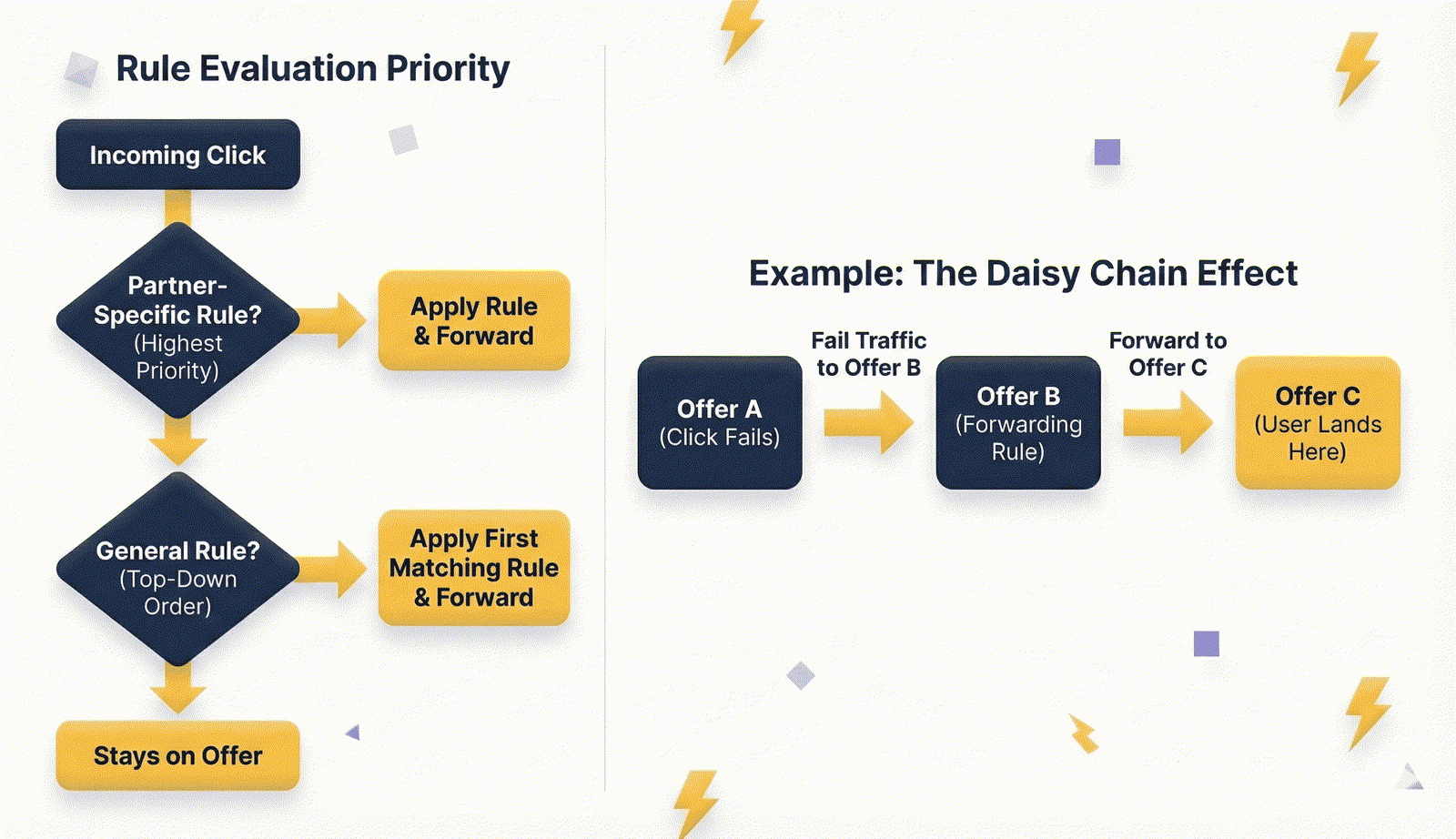
Understanding Priority: Which Rule Wins?

If you have multiple rules active, Everflow evaluates them in this strict order:

  • Partner-Specific Rules (Highest Priority): A rule targeting Partner 123 specifically will always run before a rule targeting "All Partners."
  • Top-Down Order: If multiple rules apply to the same partner, the system selects the First Active Rule in the list that matches the click criteria.
  • Fail Traffic (Last Resort): If the click is forwarded to Offer B, and Offer B also rejects it (e.g., Cap reached), Offer B's Fail Traffic rules will then take over.

Example: The "Daisy Chain" Effect Traffic can move through multiple rules.

  • Scenario: Offer A has Fail Traffic sending to Offer B. Offer B has a Forwarding Rule sending to Offer C.
  • The Path: Click (Offer A) -> Fails to -> Offer B -> Forwards to -> Offer C.
  • Result: The user lands on Offer C.
__wf_reserved_inherit

Troubleshooting: How to See Forwarded Traffic

When a click is forwarded, it is technically "Invalid" on the original Offer (because it didn't stay there) and "Valid" on the new Offer.

4
The Click Report (Forensics)
To confirm traffic is forwarding correctly:
Go to
Reporting -> Click
.
Filter by the
Original Offer
.
Look for clicks with Status
Invalid
(Red X).
Check the
Error Message
column for: Error Code 29: FORWARDED_RULE. This confirms the rule worked and the click was moved.
5
The Flowchart (Visual Confirmation)
The best way to see the journey is visually.
In the Click Report, find the forwarded click row.
Click the
vertical dots
and select
View Flowchart
.


What you will see: The path will show the click hitting the first offer, then drawing a line connecting to the second offer. This proves the hand-off was successful.
Payout Warning
If you forward traffic to a new Offer, check the
Pay Partner
setting on that destination Offer. If disabled, the Partner will track conversions but earn $0.

Full Priority Tie-Breaker Order

When several active rules could apply to the same click, Everflow ranks them using a strict tie-breaker order (the higher the rank, the higher the priority):

  1. More variables > fewer variables: A rule with more targeting variables outranks a rule with fewer.
  2. Specific Partner > all Partners: A rule that applies to a specific Partner outranks one that applies to all Partners.
  3. Date-bound > no dates: A rule with a start/end date outranks a rule with no dates set.
  4. Newer > older: A rule created more recently outranks one created earlier.

If two or more Forwarding Rules still conflict after these checks, the most recently created rule prevails.

Every Variable Needs a Matching Value
For a Forwarding Rule to fire,
every variable you configure must have a matching value in the click
. For example, if the rule requires Sub1 = chest and Sub2 = shoulder, only a click that passes both values will be forwarded (e.g. ?sub1=chest&sub2=shoulder).

Forwarding Rules vs. Custom Landing Pages: Forwarding Rules are essentially the first thing evaluated in the click path, so they always take priority over Custom Landing Page settings.