


.svg)

Overview
Offer Groups are not just organizational folders—they are a powerful Financial Control Tool. They allow you to set a single Shared Cap (Budget, Click, or Conversion limit) that applies across multiple related Offers simultaneously.
Why Use Offer Groups?
Imagine you have a $10,000 monthly budget for a "Holiday Sale" that includes 5 different products (Offers).
- Without Offer Groups: You have to guess how to split the money (e.g., $2,000 per offer). If one product is popular and hits its cap, it stops, while the other $8,000 sits unused on unpopular products.
- With Offer Groups: You set one $10,000 cap for the whole group. The budget flows naturally to the top-performing products. Once the total $10,000 is hit, all offers in the group stop together.
Key Constraints
- Advertiser Link: An Offer Group is tied to a single Advertiser. All Offers inside the group must belong to that Advertiser.
- Hard Caps: Offer Group caps are "Hard Caps." When the limit is reached, traffic is blocked immediately.
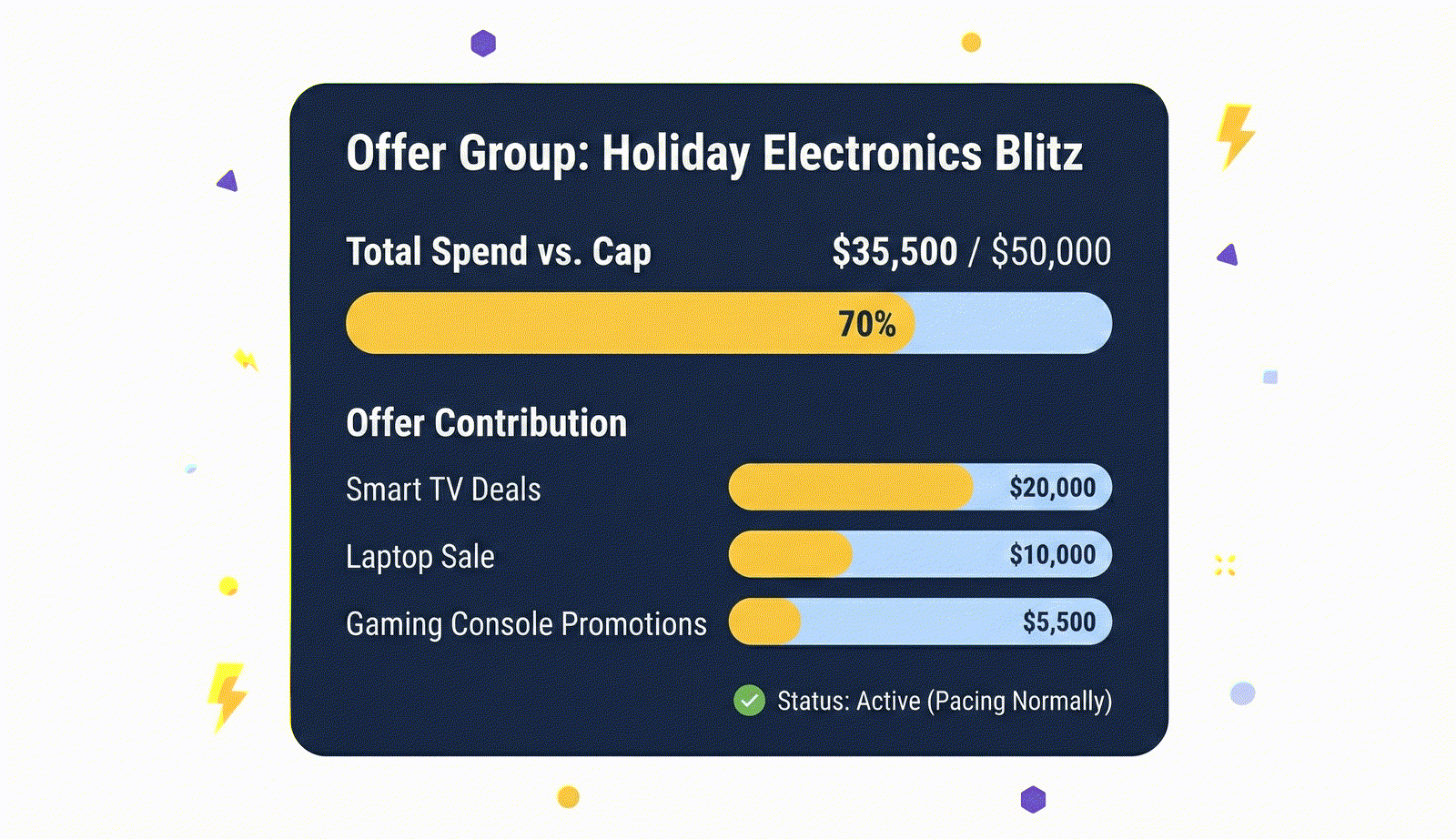
Practical Example: Holiday Electronics Blitz
Imagine you are managing marketing for an electronics store during Q4. You want to promote multiple product categories without losing control of your total spend.
The Setup:
The Benefit:
The Setup:
Offer Group Name: Holiday Electronics Blitz
Included Offers:
Offer A: Laptop Sale
Offer B: Smart TV Deals
Offer C: Gaming Console Promotions
Total Group Budget (Cap): $50,000
The Benefit:
Flexibility: If "Smart TVs" are selling fast and "Laptops" are slow, the Smart TVs can use up more of the $50,000 budget automatically. You don't have to manually move money around.
Safety: As soon as the total group spend hits $50,000, all three offers pause.
Step-by-Step Setup
1
Create the Group
Navigate to
Offers -> Groups
.Click
Add Offer Group
.Name:
Give it a descriptive name (e.g., "Q4 Holiday Budget").Advertiser:
Select the Advertiser. Note: This determines which Offers you can add later.2
Define the Shared Cap
This is the aggregate limit for all offers combined.
Cap Interval:
Daily, Weekly, Monthly, or Global (All-time).Cap Type:
Conversion / Revenue / Payout: Best for financial budgeting.
Click: Best for controlling traffic volume.
Status:
Set to Active
.3
Add Offers to the Group
Click the
Offers
tab within the Group settings.Select the Offers you want to share this budget.
Save
the Group.Rules of Precedence (Priority Logic)
When you have multiple caps active (e.g., an Offer Group Cap AND a Partner-Level Cap), Everflow follows a strict rule:
The "First Reached" Rule: The system enforces whichever cap is reached first.
The Scenario:
- Offer Group Cap: 1,000 Conversions (Shared).
- Partner A Custom Cap: 100 Conversions (Individual).
The Outcome:
- If the Group hits 1,000 conversions first, Partner A stops, even if they only drove 50 conversions. The shared budget is exhausted.
- If Partner A hits 100 conversions first, Partner A stops, but the rest of the group keeps running until the 1,000 limit is hit.
What Happens When a Group Cap is Reached?
Offer Group Caps are Hard Caps. When the limit is hit, the following happens immediately for ALL Offers in the group:
- Traffic Blocked (Invalid Clicks): Any new click sent to any offer in the group is rejected and marked as Invalid.
- Safety Net: If the individual Offers have Fail Traffic configured, these clicks will be redirected to the Fail Traffic destination (monetizing the overflow).
- Late Conversions (Pending): If a user clicked before the cap was hit but converted after the cap was hit, the conversion is marked as Pending. You must manually approve these if you wish to pay for them.
Diagnostics & Reporting
How do you know if the Group Cap is the reason traffic stopped?
1
The Click Report (Forensics)
To confirm the Group Cap caused the block:
Go to
Reporting -> Click
.Filter by
Invalid
clicks.Check the
Error Code
column.Look for: Error Code 3: INVALID_OVER_OFFER_GROUP_CAP.
2
The Dynamic Nested Report (Optimization)
Use this report to see which specific Offer is consuming the shared budget.
Go to
Reporting > Dynamic Nested
.Drill Down:
Set the first dimension to Offer Group
and the nested dimension to Offer
.Analyze: You will see the total Group performance broken down by each child Offer. This helps you identify if one high-volume Offer is "eating" the budget for everyone else.


